

London heritage building renovation is the process of restoring and upgrading protected historic properties while complying with complex conservation regulations and preserving architectural character. The industry term for this work is building conservation, and it covers everything from Listed Building Consent applications to the careful selection of breathable lime mortars. London presents a uniquely demanding environment for this work. Renovation costs run 30–45% higher than the UK average, planning requirements are borough-specific, and the consequences of non-compliance can include enforcement notices, criminal prosecution, and forced reinstatement. This guide covers the consents, costs, materials, and project management practices you need to deliver a compliant, high-quality result.
What permissions are required for london heritage building renovations?
The regulatory framework for heritage building restoration in London operates on several overlapping layers. Understanding which consents apply to your property before you begin is not optional. Getting this wrong can halt a project mid-build.
Listed Building Consent is required for any work that affects the character of a listed building, internally or externally. This applies to Grade I, Grade II*, and Grade II listed properties. It is separate from planning permission, and you may need both. The local planning authority grants Listed Building Consent, and works carried out without it constitute a criminal offence with no time limit on prosecution.

Conservation areas and Article 4 Directions add another layer of control. Approximately 30% of London's residential streets lie within conservation areas, and Article 4 Directions remove permitted development rights for many common works. This means full planning permission may be required for window replacements, roof alterations, and external cladding changes that would normally be exempt elsewhere in the UK. You can check your borough's planning portal, such as the London Borough of Ealing's planning search or Islington Council's online system, to confirm whether your property falls within a designated area.
The key consents and notifications to check before starting any works include:
- Listed Building Consent for any alterations to a listed structure
- Planning permission for extensions, changes of use, or works in conservation areas
- Article 4 Direction status via your borough's planning portal
- Party Wall Act 1996 notices served on adjoining owners before excavation or structural works
- Building Regulations approval for structural, fire safety, and energy performance works
The Party Wall Act 1996 requires notices to be served at least two months before works begin. Failure to serve notice causes major project delays and can expose you to legal action from neighbours. Budget between £1,500 and £4,000 per party wall agreement. In London terraces, multiple agreements are common, so this cost adds up quickly.
Pro Tip: Check your property's listing status and conservation area designation on Historic England's National Heritage List for England before commissioning any design work. This shapes every decision that follows.
How to budget for heritage renovation costs in london
Budgeting for a heritage renovation in London requires a different mindset than a standard residential project. The cost premiums are real and specific.
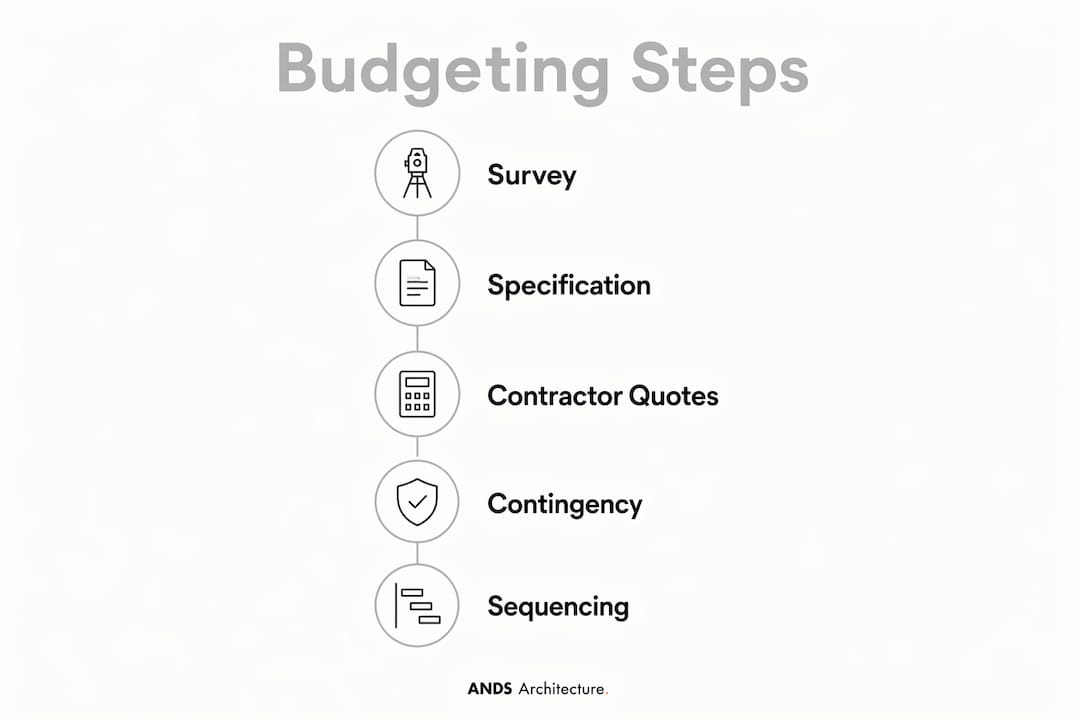
London renovation costs run 30–45% higher than other UK regions. That premium reflects specialist heritage labour, parking suspensions for skips and deliveries, and the rigorous planning requirements that add professional fees and time. Without a detailed specification prepared before works begin, budgets fall 20–40% short of actual costs. That shortfall is not bad luck. It is the predictable result of starting construction without fully resolved design decisions.
The most common hidden costs in London heritage renovations are:
- Specialist heritage labour for lime plastering, timber sash restoration, and traditional masonry work
- Parking suspensions for skips, scaffolding, and delivery vehicles, which can cost several hundred pounds per week in inner London
- Party wall surveyor fees across multiple agreements in terrace properties
- Heritage statements and condition surveys required by local planning authorities before consent is granted
- Unforeseen structural repairs uncovered once works begin, particularly in Victorian and Edwardian properties with historic unrecorded alterations
A contingency reserve of 15–20% of the total budget is the professional standard for London heritage projects. This is not a buffer for poor planning. It reflects the genuine uncertainty of working within historic fabric where previous alterations may not be documented.
Pro Tip: Commission a detailed condition survey and full specification before requesting contractor quotes. Vague scope documents produce wildly varying quotes that are impossible to compare and almost always underestimate the final cost.
Sequencing works correctly also protects your budget. Building health must come first: structural stabilisation, then damp proofing, then first-fix services, then plastering, then second-fix joinery, and finally finishing. Reversing this order, for example plastering before resolving damp, creates expensive rework and can damage historic fabric irreparably.
What are best practices for preserving architectural character?
Preserving the architectural character of a heritage property is not simply about aesthetics. It is a regulatory requirement and a long-term investment in building health. The most common mistakes in this area come from applying modern construction products to historic structures that were designed to breathe.
Modern cement-based plasters trap moisture in historic brickwork, causing decay in the masonry behind. Breathable lime-based plasters and mortars allow moisture to migrate naturally through the wall, which is how Victorian, Edwardian, and Georgian buildings were designed to function. Replacing lime with cement is one of the most damaging interventions you can make in a period property, and it is also one of the most common.
Key material and design principles for preserving historic integrity include:
- Use lime-based mortars and plasters rather than cement-based products on all masonry and internal walls
- Retain original timber sash windows where possible; uPVC replacements are typically refused in conservation areas and listed buildings
- Match existing brick bonds, stone dressings, and roof tile profiles when repairing or extending
- Specify traditional paint systems on external joinery, such as oil-based primers on timber, rather than modern masonry coatings
- Retain original cornicing, ceiling roses, and architraves rather than removing and replacing with modern equivalents
The distinction between restoration and renovation matters here. Restoration returns a building to a known earlier state. Renovation updates it for modern use while retaining its character. Most London heritage projects involve renovation: keeping the original staircase, retaining the Victorian tiled hallway floor, and restoring the sash windows, while installing underfloor heating, updated electrics, and a contemporary kitchen to the rear. This balance is achievable, but it requires a design-led approach from the outset.
Integrating modern comforts without losing heritage features is a design challenge, not a technical one. Underfloor heating can be installed beneath existing floorboards with minimal disruption. Mechanical ventilation with heat recovery can be concealed within ceiling voids. Secondary glazing provides thermal performance in listed buildings where double glazing is refused. These solutions exist precisely because the heritage sector has developed them over decades of practice.
Pro Tip: Always consult a conservation accredited architect or specialist before specifying materials for a listed building. Historic England's Building Conservation Directory lists accredited practitioners by region.
What steps ensure successful project delivery for heritage renovations?
Effective project management for London heritage renovations depends on one principle above all others: resolve design decisions before construction begins. Decisions made during construction cost 2–5 times more than the same decisions made at design stage. Premature construction starts lead to structural failures, conservation non-compliance, and budget overruns that are entirely avoidable.
The recommended sequence for managing a heritage renovation project is:
- Commission a measured survey and condition report to establish the existing state of the building accurately
- Prepare a heritage statement documenting the significance of the building and the rationale for proposed works
- Appoint your architect, structural engineer, and conservation specialist before any design work begins
- Complete the full design and obtain all consents before appointing a contractor
- Serve Party Wall Act notices as early as possible, ideally before planning submission
- Appoint a contractor with demonstrable heritage experience and check references on comparable projects
- Maintain a comprehensive record of all approvals, structural inspections, and building control visits throughout the project
Early integration of design and construction teams reduces the gap between preservation intent and final result. A turnkey model where a single team manages both design and delivery is considered the most effective approach for high-value London heritage projects. It removes the adversarial dynamic between designer and contractor that so often drives up costs and compromises quality.
Maintaining a detailed paper trail of approvals, structural inspections, and building control visits is not bureaucracy. It is the evidence base that allows you to pass final inspections, sell the property without complications, and demonstrate compliance if enforcement action is ever threatened. Keep digital copies of every consent, every drawing revision, and every site inspection report.
London's urban context adds specific site management challenges. Restricted access, shared party walls, proximity to neighbours, and limited storage space for materials all require careful programming. Engaging a specialist architect early in the process helps anticipate these constraints before they become costly problems on site.
Key takeaways
Successful London heritage building renovation requires regulatory compliance, correct material specification, and a design-first approach to project management.
| Point | Details |
|---|---|
| Secure consents before starting | Listed Building Consent and planning permission must be in place before any works begin on protected properties. |
| Budget for London's cost premium | Renovation costs run 30–45% higher than the UK average; hold a 15–20% contingency for unforeseen works. |
| Use breathable materials | Lime-based plasters and mortars protect historic masonry; cement-based products cause long-term decay. |
| Resolve design before construction | Decisions made on site cost 2–5 times more than those resolved at design stage. |
| Build a comprehensive paper trail | Records of all consents, inspections, and approvals protect you at completion and on future sale. |
Why heritage renovations reward those who respect the process
I have worked on heritage projects across London for over two decades, and the pattern I see most often is this: the clients who struggle are those who treat the regulatory framework as an obstacle. The clients who succeed treat it as a design brief.
Listed Building Consent and conservation area rules are not arbitrary restrictions. They encode decades of hard-won knowledge about what damages historic buildings and what preserves them. When a planning officer insists on lime mortar or refuses uPVC windows, they are protecting the long-term value of your asset, not obstructing your project.
The other lesson I would share is about team assembly. I have seen projects where the architect, structural engineer, and contractor were appointed at different stages and barely communicated. The result was always the same: late discoveries, expensive variations, and a final product that fell short of what the client envisaged. The projects that deliver exceptional results are those where the whole team sits around the table before a single drawing is produced.
Heritage renovation in London is genuinely more complex than standard residential work. But it is also more rewarding. A well-executed conservation project adds character, value, and longevity to a building in ways that a modern new-build simply cannot replicate. Embrace the constraints. They are what make the result worth having.
— Afraz
How Andsarchitecture supports london heritage renovations
Andsarchitecture brings over 20 years of experience to heritage building projects across London, from conservation area extensions in Islington to listed building renovations in Ealing and Chiswick. Our architectural services cover every stage of a heritage project: measured surveys, heritage statements, Listed Building Consent applications, building regulations drawings, and full project delivery.

We work closely with homeowners, developers, and contractors to prepare bespoke specifications that protect historic fabric and satisfy planning requirements. Our planning application support includes pre-application advice, conservation area assessments, and liaison with local authority heritage officers. If you are planning a heritage renovation in London and want to protect your investment from the outset, contact Andsarchitecture to book a consultation. We will help you understand your consents, your costs, and your options before you commit to a single decision.
FAQ
What is listed building consent and when do i need it?
Listed Building Consent is a statutory permission required for any works that affect the character of a listed building, internally or externally. You need it in addition to planning permission, and carrying out works without it is a criminal offence.
Do i need planning permission to replace windows in a conservation area?
In many London conservation areas, Article 4 Directions remove permitted development rights, meaning window replacements require full planning permission. Check your borough's planning portal to confirm the rules for your specific property.
How much contingency should i hold for a london heritage renovation?
A contingency of 15–20% of the total project budget is the professional standard for London heritage renovations, reflecting the likelihood of unforeseen structural or damp-related discoveries in historic buildings.
Can i install double glazing in a listed building?
Double glazing is typically refused in listed buildings. Secondary glazing is the accepted alternative, providing meaningful thermal improvement while preserving the original window frames and appearance.
How early should i serve party wall act notices?
Notices under the Party Wall Act 1996 must be served at least two months before works begin. Serving them early, ideally before planning submission, avoids delays and gives adjoining owners adequate time to respond.