
A London new build planning guide is a structured framework covering every regulatory approval, design decision, and compliance checkpoint required before a single brick is laid on a new residential project in the capital. Unlike extensions or conversions, new builds require full planning permission with no permitted development rights available. The regulatory framework involves three key players: the local planning authority (LPA), Building Control Bodies, and the Building Safety Regulator. Layered on top is the London Plan, a strategic document produced by the Mayor of London that shapes density, design quality, and sustainability expectations across all 33 boroughs. The 2026 updates to the Building Regulations have also introduced tighter energy and ventilation standards that every new build project must now meet.
What planning permissions are required for London new builds?
Planning permission for a new build in London is non-negotiable. There are no permitted development rights for entirely new dwellings, which means every new residential project, from a single self-build home in Bromley to a multi-unit scheme in Tower Hamlets, must go through the full planning permission process with the relevant LPA.
The planning process follows a clear sequence:
- Pre-application consultation with the LPA to discuss the proposal, identify constraints, and receive informal feedback before submitting.
- Preparation of drawings and supporting documents, including a Design and Access Statement, planning drawings, and any required specialist reports such as flood risk assessments or heritage statements.
- Submission of the full planning application via the Planning Portal, accompanied by the correct fee.
- Statutory consultation period of 21 days, during which neighbours, statutory consultees, and the public can submit representations.
- Decision by the LPA, typically within eight weeks for minor applications and 13 weeks for major schemes.
Beyond planning permission, you also need building control approval, which is a separate process entirely. Planning permission confirms that the principle of development is acceptable. Building control approval confirms that the construction meets technical standards under the Building Regulations 2010.
For higher-risk buildings, defined as residential buildings with two or more units, the Building Safety Regulator must grant approval before any construction begins. Failure to obtain this approval results in a legal prohibition on starting work.

Pro Tip: Submit a pre-application enquiry to your LPA before preparing full drawings. Many London boroughs offer a paid pre-application service that can save months of abortive design work by flagging policy conflicts early.
How do the 2026 Building Regulations affect new builds?
The 2026 amendments represent the most significant update to residential construction standards in a generation. The Future Homes and Buildings Standards introduce mandatory requirements for low-carbon heating, high levels of thermal performance, and improved ventilation across all new dwellings. New energy efficiency regulations come into force on 24 March 2027, with specific transition arrangements for higher-risk buildings applying from September 2027.
The key technical requirements under the updated Approved Documents L and F are:
- Thermal performance (Approved Document L): Maximum U-values of 0.18 W/m²K for walls, 0.15 W/m²K for roofs, 0.18 W/m²K for floors, and 1.2 W/m²K for windows.
- Primary energy cap: New dwellings must not exceed 95 kWh/m²/year in primary energy consumption.
- Air permeability: Maximum 5.0 m³/h.m² at 50Pa, tightening the standard from previous requirements.
- Ventilation (Approved Document F): Mechanical ventilation with heat recovery (MVHR) is now the practical default for most new homes to meet both air quality and energy targets simultaneously.
- Heating systems: Gas boilers are effectively designed out of new builds under the Future Homes Standard, with heat pumps and district heating networks as the primary alternatives.
The table below summarises the headline performance targets:
| Performance metric | 2026 requirement |
|---|---|
| External wall U-value | 0.18 W/m²K maximum |
| Roof U-value | 0.15 W/m²K maximum |
| Floor U-value | 0.18 W/m²K maximum |
| Window U-value | 1.2 W/m²K maximum |
| Primary energy use | 95 kWh/m²/year maximum |
| Air permeability | 5.0 m³/h.m² at 50Pa maximum |
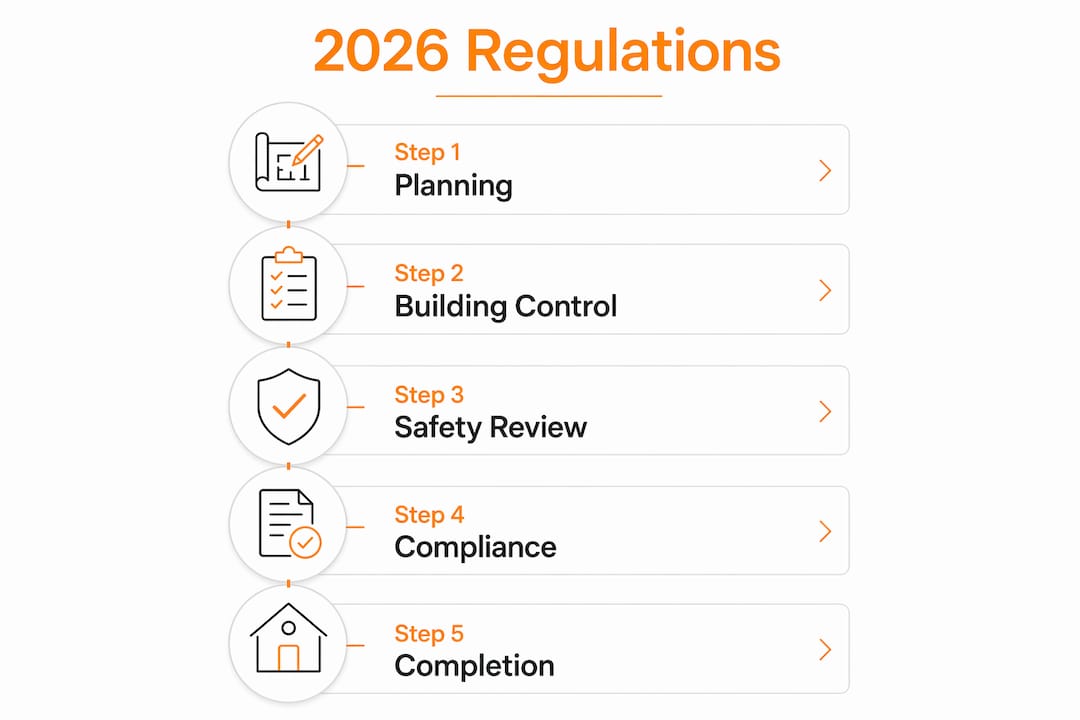
Following Approved Documents is the most direct method to demonstrate compliance. Alternative technical solutions are permitted but require rigorous proof that functional requirements are met, which adds cost and time to any project. For most developers and self-builders, the Approved Document route is the practical choice.
Pro Tip: Commission a Standard Assessment Procedure (SAP) energy assessment at concept design stage, not at planning submission. Discovering that your proposed construction specification fails the primary energy cap after planning approval is granted means costly redesign.
What is the step-by-step process for planning a new build in London?
Executing a new build project in London without a clear process framework is how budgets overrun and programmes slip. The following sequence reflects best practice for residential new builds across London boroughs, from Hackney to Richmond.
-
Assemble your professional team early. At minimum, you need an architect, a structural engineer, and a building control body appointed before any application is submitted. For larger schemes, add a planning consultant, mechanical and electrical engineer, and a principal designer under the Construction Design and Management (CDM) Regulations 2015.
-
Conduct a thorough site appraisal. This includes a measured survey, ground investigation, and checks on planning history, listed building status, conservation area designations, and any Section 106 obligations on the land.
-
Develop your design to planning stage. Work with your architect to produce drawings that respond to the LPA's local design guide, the London Plan's design policies, and any pre-application feedback received. Andsarchitecture's design and build services cover this process from concept through to planning submission.
-
Submit the Full Plans application for building control. The Full Plans route is strongly recommended over the Building Notice route for new dwellings. Starting work under a Building Notice without approved plans risks non-compliance, costly remedial works, and potential legal enforcement. Full Plans approval gives you certainty before breaking ground.
-
Manage inspections systematically. Building control inspections occur at defined stages: commencement, foundations, damp proof course, structural frame, roof structure, drainage, and completion. Missing an inspection stage can result in the building control body requiring opening up works to verify compliance.
-
Integrate sustainability and accessibility from the outset. Part M (accessibility) and Part O (overheating) requirements apply to all new dwellings. Overheating compliance in London is particularly demanding given the urban heat island effect across central and inner boroughs.
Pro Tip: Maintain a compliance log throughout construction. Record every inspection, every material specification change, and every communication with your building control body. This log becomes your evidence base if compliance is ever questioned and speeds up the final certificate process significantly.
How to handle building control and fire safety for new builds
Building control for new builds in London can be provided by either the local authority building control (LABC) team or a private Approved Inspector. Both have enforcement powers and both issue the final certificate required for lawful occupation. The choice affects inspection timelines and service responsiveness, so it is worth obtaining quotes and references from both routes before appointing.
For higher-risk buildings, the Building Safety Regulator takes over as the building control authority. This means:
- Registration of the building with the Building Safety Regulator before construction begins.
- Submission of a Gateway 2 application (building control approval) with full plans, which must be approved before work starts on site.
- A staged application process is available for complex projects, allowing phased approvals to keep the programme moving without waiting for a single monolithic approval.
- A Gateway 3 completion certificate from the Building Safety Regulator is required before the building can be occupied.
Fire safety requirements have been significantly strengthened following the Hackitt Review. Under the updated Approved Document B, new homes require mains-powered interlinked smoke and heat alarms throughout. Fire resistance periods for structural elements are determined by the building's height, with taller buildings requiring longer fire resistance ratings. The Fire and Rescue Authority is a statutory consultee for higher-risk buildings, and their representations carry significant weight in the approval process.
The Building Safety Regulator's Gateway process is not a formality. Applications that arrive without complete, coordinated drawings are rejected, adding months to the programme. Invest in thorough technical documentation before submission.
Pro Tip: For any new build over 11 metres in height, appoint a fire engineer at RIBA Stage 2. Their input shapes the structural strategy, means of escape, and compartmentation design before these elements become expensive to change.
Key takeaways
Successful London new build projects depend on securing the right approvals in the right sequence, meeting the 2026 Building Regulations from design stage, and assembling a professional team before any application is submitted.
| Point | Details |
|---|---|
| Full planning permission is mandatory | New builds in London have no permitted development rights; every project needs LPA approval. |
| 2026 regulations set strict energy targets | New dwellings must not exceed 95 kWh/m²/year and must meet tighter U-value and air permeability standards. |
| Full Plans route protects your investment | The Building Notice route risks costly remedial works; Full Plans approval confirms compliance before work begins. |
| Higher-risk buildings need BSR approval | The Building Safety Regulator must approve plans and register the building before construction starts. |
| Fire safety requirements have increased | Mains-powered interlinked alarms and height-based fire resistance periods are now mandatory in all new homes. |
What I have learned from London's evolving planning environment
The single most consistent mistake I see from developers and self-builders approaching a new build project in London is treating planning permission and building control as two separate, sequential processes. They are not. The decisions you make at planning stage, your floor-to-ceiling heights, your structural grid, your facade specification, directly determine whether your building control application succeeds or requires expensive redesign.
The 2026 regulatory changes have made this integration more critical than ever. The Future Homes Standard effectively requires you to design your mechanical systems, your insulation specification, and your airtightness strategy at the same time as your architectural concept. Architects who still treat energy compliance as something to be resolved by the M&E engineer after planning approval is granted are setting their clients up for programme delays and cost overruns.
I also think the industry underestimates how much the Building Safety Regulator has changed the pace of higher-risk building projects. Gateway 2 applications are being returned for additional information at a significant rate. The lesson is not to submit faster. The lesson is to spend more time on technical coordination before submission, because a rejected application costs far more in time than a thorough pre-submission review.
For homebuyers considering a new build purchase rather than a self-build, the regulatory environment is equally relevant. Understanding whether a developer has secured Gateway 3 sign-off, and whether the building has a valid final certificate, is now a standard part of conveyancing due diligence. Our building regulations compliance guide covers what to look for in detail.
The London planning system rewards preparation. Boroughs like Southwark, Camden, and Islington have detailed local design guides that go well beyond national policy. Knowing those guides before you design, rather than after you submit, is the difference between an approval at first attempt and a protracted negotiation.
— Afraz
Plan your London new build with Andsarchitecture

Andsarchitecture brings over 20 years of experience to residential new build projects across London, from single dwellings in outer boroughs to multi-unit schemes in the heart of the city. Our team manages the full process: pre-application consultation, planning drawings, building control submissions under the Full Plans route, and compliance with the 2026 Building Regulations. We coordinate architects, engineers, and building control bodies so that your project moves from concept to completion without the regulatory delays that derail so many new builds. If you are at the early stages of a project or reviewing a site, speak with our team at Andsarchitecture to discuss your specific requirements. For planning-specific support, our residential planning services are tailored to London's regulatory environment.
FAQ
Do new builds in London always need full planning permission?
Yes. New builds in London have no permitted development rights, so full planning permission from the relevant local planning authority is required for every new residential dwelling, regardless of size or location.
What are the main 2026 Building Regulations changes for new homes?
The Future Homes and Buildings Standards introduce maximum U-values for walls, roofs, floors, and windows, a primary energy cap of 95 kWh/m²/year, and tighter air permeability limits. These apply to new dwellings with energy efficiency regulations coming into force on 24 March 2027.
What is the difference between planning permission and building control approval?
Planning permission confirms that the principle and design of a development is acceptable to the local authority. Building control approval confirms that the construction meets the technical standards set out in the Building Regulations 2010. Both are required before a new build can be lawfully occupied.
When is the Building Safety Regulator involved in a new build?
The Building Safety Regulator is the building control authority for higher-risk buildings, defined as residential buildings with two or more units. Registration and Gateway 2 plan approval must be secured before construction begins, and a Gateway 3 completion certificate is required before occupation.
Is the Full Plans route or Building Notice route better for new builds?
The Full Plans route is strongly recommended for all new dwellings. Starting work under a Building Notice without approved plans risks non-compliance, remedial works, and legal enforcement. Full Plans approval provides certainty that your design meets the Building Regulations before any work begins on site.