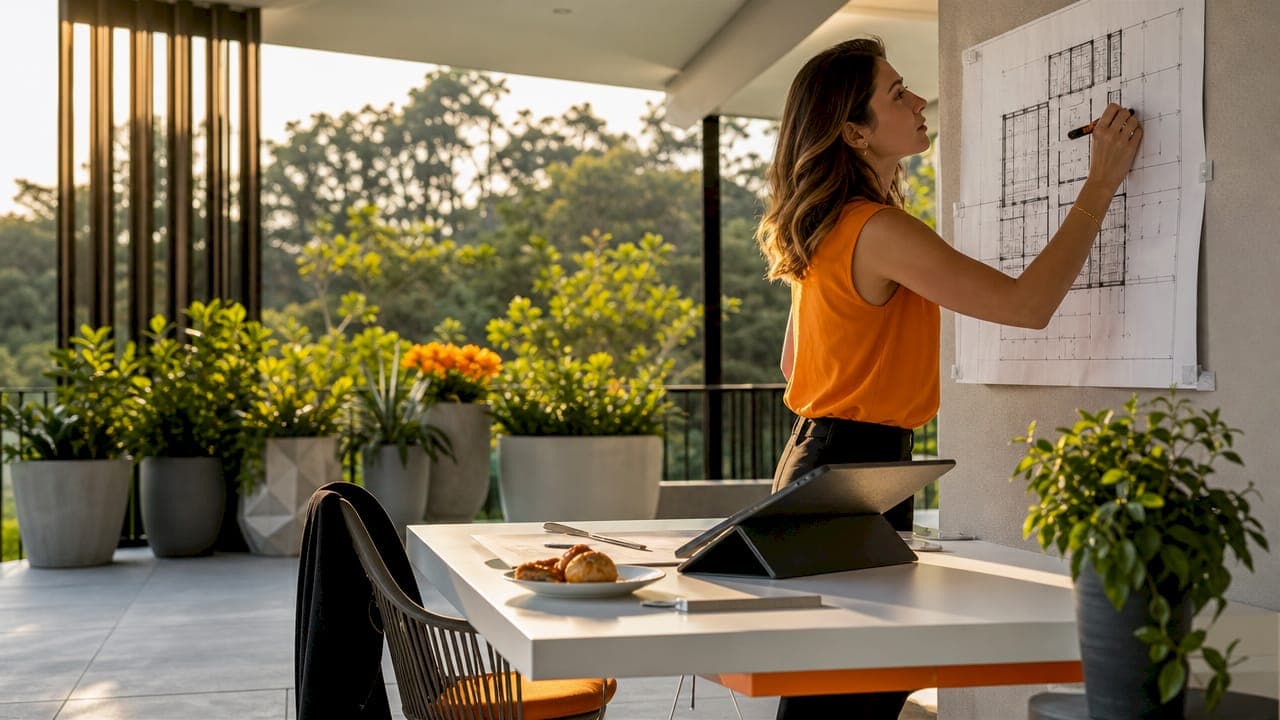
A residential scheme design is the foundational architectural phase in which a client’s brief, lifestyle requirements, and site conditions are translated into organised floor plans, exterior elevations, and a defined building form. Known formally as schematic design, this stage precedes all detailed technical drawings and specification work. It establishes the spatial organisation, building massing, and site placement that will govern every subsequent decision in the project. Practices such as ANDS Architecture and tools like Vectorworks describe this phase as the critical bridge between a client’s vision and the construction documents that follow. Getting it right at this stage protects your budget, your timeline, and the long-term liveability of your home.
What are the key components of a residential scheme design?
Schematic design transforms a client’s brief and lifestyle requirements into organised floor plans, site placement, and massing. These are not polished, construction-ready drawings. They are decision-making tools, produced specifically to help you and your architect agree on the big picture before committing to costly detail.
The primary deliverables at this stage include:
-
Floor plans showing room sizes, adjacencies, and circulation routes through the building
-
Exterior elevations indicating the building’s height, roof form, and relationship to neighbouring properties
-
Site layout drawings illustrating how the building sits on the plot, including access, parking, and garden areas
-
Massing studies exploring the three-dimensional volume of the building and how it responds to its surroundings
-
Design options presenting two or three alternative approaches for client review and comparison
Spatial relationships and traffic flow are considered from the outset. A well-resolved scheme design ensures that the kitchen connects logically to the dining area, that bedrooms are separated from noisy living spaces, and that natural light reaches the rooms where it matters most. These decisions feel abstract at this stage but they define how comfortable and functional your home will ultimately be.
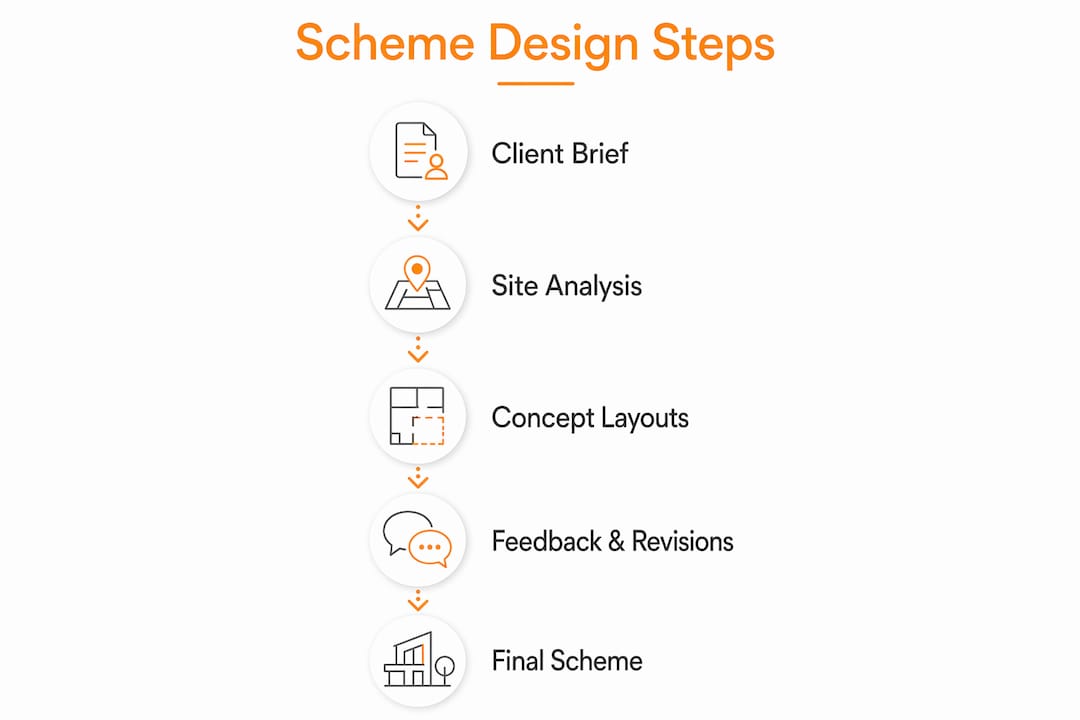
The phase also involves multiple iterations. Your architect will present options, receive your feedback, refine the drawings, and present again. Landis Construction notes that initial design phases define the project’s feel and scope, shaped heavily by site constraints and your daily patterns of living. This iterative process is not inefficiency. It is the mechanism by which a generic brief becomes a bespoke design.

In terms of duration, schematic design typically lasts 4 to 8 weeks for residential additions and renovations, and 6 to 10 weeks for custom homes. That timeline reflects the complexity of the decisions being made, not the volume of drawings being produced.
Pro Tip: Ask your architect to present at least two distinct layout options during the scheme design phase. Comparing alternatives forces clarity about your priorities and almost always produces a better final design than refining a single option in isolation.
How does residential scheme design relate to urban design?
Residential scheme design and urban design operate at different scales, but they are not independent disciplines. Understanding the distinction helps you appreciate why your architect considers factors well beyond your plot boundary when developing your scheme.
| Aspect | Residential scheme design | Urban design |
|---|---|---|
| Scale | Individual building or small development | Neighbourhood, district, or city quarter |
| Primary focus | Spatial layout, massing, and site placement | Public realm, movement networks, and land use |
| Key outputs | Floor plans, elevations, site drawings | Masterplans, design codes, public space strategies |
| Regulatory context | Planning permission, building regulations | Local development frameworks, design guides |
| Client | Homeowner or private developer | Local authority, developer consortium, or government body |
Urban design is a multidisciplinary approach that improves the interaction between public and private space, considering history, ecology, and human behaviour. This means that when your architect designs your home, they are also responding to the character of the street, the scale of neighbouring buildings, and the pedestrian experience at your boundary. A residential scheme that ignores its urban context tends to attract planning objections and produces homes that feel out of place.
Residential scheme design is increasingly integrated within broader urban design processes, particularly on larger development sites. A terrace of new homes, for example, must address not just the internal layout of each dwelling but the collective streetscape, shared amenity space, and connections to public transport. The two disciplines inform each other constantly.
For homeowners extending or remodelling a single property, the urban design dimension is most visible in planning policy. Local authorities publish design guides and character assessments that set expectations for materials, roof forms, and building lines. Your architect’s scheme design must respond to these documents to secure planning permission efficiently.
What practical steps should clients focus on during scheme design?
The scheme design phase demands active participation from you as a client. Passive approval of drawings is not enough. Successful participation requires clear, decision-oriented feedback rather than vague aesthetic impressions. “I’m not sure about this” is not useful. “The kitchen feels disconnected from the garden” gives your architect something to work with.
Here are the key decisions and actions to prioritise during this phase:
-
Confirm your programme. Agree on the number and type of spaces required before your architect begins drawing. Adding a home office or a utility room after the layout is established forces expensive reworking.
-
Evaluate building orientation. Discuss how the building should be positioned to maximise natural light, capture views, and protect privacy. Site analysis during the schematic phase directly influences orientation for light optimisation, shading, and sustainability goals.
-
Assess each design option critically. When your architect presents alternatives, evaluate them against your daily routines, not just their appearance. Walk through the plan mentally from arrival at the front door to waking up in the morning.
-
Understand regulatory constraints early. Engage with planning policy and any site-specific restrictions before the scheme is too advanced. Your architect’s planning services should include a pre-application assessment of what is likely to be acceptable.
-
Agree on right-sizing. Larger is not always better. Oversized rooms increase build cost and heating bills without improving liveability. Use the scheme design phase to challenge assumptions about space requirements.
-
Avoid premature focus on finishes. Choosing kitchen units or bathroom tiles before the layout is resolved is a common and costly mistake. Scheme design is about organisation and form, not specification.
Decisions made during schematic design, such as building footprint and orientation, are costly to change once finalised. A structural wall relocated after planning permission is granted can add thousands of pounds to your project. The scheme design phase is your lowest-cost opportunity to get these decisions right.
Pro Tip: Before your first scheme design meeting, prepare a written brief that describes how you live: when you cook, where you work, how you entertain, and what you find frustrating about your current home. This brief is more useful to your architect than any Pinterest board.
Which elements of residential layout design shape comfort and functionality?
Residential layout design is the discipline of arranging spaces within a building to support the way people actually live. It is distinct from interior design, which addresses surfaces and furnishings. Layout decisions made during the scheme design phase have a permanent effect on your home’s comfort, functionality, and sustainability.
The core elements that shape a successful residential layout include:
-
Logical space organisation. Logical organisation of spaces and smooth flow enhances comfort and functionality. Wet rooms (kitchens and bathrooms) grouped together reduce plumbing runs and cost. Quiet zones (bedrooms and studies) separated from active zones (living and kitchen) reduce noise conflict.
-
Natural light and orientation. South-facing living spaces receive the most daylight in the UK. Bedrooms oriented east capture morning light. North-facing rooms require careful design to avoid feeling dark and cold.
-
Adaptable spaces. A spare bedroom that can function as a home office, a ground-floor room that can become an accessible bedroom in later life. These decisions cost little at the design stage and add significant long-term value.
-
Circulation efficiency. Corridors and hallways consume floor area without adding usable space. Good layout design minimises circulation while maintaining privacy between rooms.
-
Sustainable design integration. Orientation, window sizing, and thermal mass are all established during the scheme design phase. Correcting a poorly oriented building after construction is not possible without demolition.
| Layout approach | Advantages | Disadvantages |
|---|---|---|
| Open-plan living | Maximises light and social connection | Noise travels freely; harder to heat efficiently |
| Cellular layout | Better acoustic separation; easier to zone heating | Can feel compartmentalised; less natural light penetration |
| Split-level design | Defines zones without full walls; adds spatial interest | More complex structurally; accessibility challenges |
| Courtyard plan | Excellent natural light to all rooms; private outdoor space | Requires larger plot; higher construction cost per square metre |
The right layout approach depends on your site, your budget, and how you live. There is no universally correct answer, which is precisely why the scheme design phase exists: to test these options before any money is spent on construction.
Key takeaways
Residential scheme design is the phase where spatial organisation, site placement, and building form are resolved, and decisions made here shape every aspect of cost, comfort, and planning success that follows.
| Point | Details |
|---|---|
| Scheme design precedes all technical work | Floor plans, elevations, and site layouts are produced before any detailed specification or structural design begins. |
| Timelines vary by project type | Additions and renovations typically take 4 to 8 weeks; custom homes require 6 to 10 weeks for this phase. |
| Client feedback drives design quality | Clear, decision-oriented responses to design options produce better outcomes than vague aesthetic impressions. |
| Layout decisions are permanent | Building orientation, footprint, and spatial organisation are costly to change after planning permission is granted. |
| Urban context shapes every scheme | Planning policy, street character, and neighbouring buildings all influence what a residential scheme can achieve. |
Why I treat scheme design as the most important phase of any project
Most clients arrive at the scheme design phase eager to talk about materials, finishes, and the look of their home. I understand the impulse. These are the things you can picture. But the scheme design phase is not about aesthetics. It is a stress test that validates feasibility against planning constraints, budget, and site conditions before a single technical drawing is produced.
The projects I have seen run into serious difficulty almost always share one characteristic: a scheme design phase that was rushed, or where the client approved drawings without genuinely engaging with the spatial logic. A beautiful elevation cannot compensate for a kitchen that receives no natural light, or a master bedroom positioned directly above a neighbour’s living room.
What I find clients consistently underestimate is how much the scheme design phase protects them financially. Changing a structural wall during construction can cost ten times what it would have cost to adjust the layout drawing. The scheme design phase is the moment when your architect’s experience and your knowledge of how you live must combine most productively. Treat it as a genuine collaboration, not a presentation to approve.
The most rewarding projects I have worked on are those where clients arrived with a written brief, asked hard questions about every option, and were willing to challenge their own assumptions about what they needed. That engagement produces homes that genuinely work, not just homes that look good in photographs.
— Afraz
How ANDS Architecture supports your residential scheme design
At ANDS Architecture, we guide clients through every stage of the residential design process, from the first site visit and measured survey through to planning submission and construction delivery. Our design and build services are structured to give you clarity at the scheme design stage, presenting well-considered options that reflect your brief, your site, and your budget.
With over 20 years of experience across residential, commercial, and development projects in the UK, we understand that the scheme design phase is where projects are won or lost. We work closely with you to resolve spatial organisation, building orientation, and planning strategy before committing to detailed technical work. Our team also supports you through UK building regulations compliance and planning applications, so that your scheme moves from concept to approval without unnecessary delay. Contact Andsarchitecture today to discuss your project and arrange an initial consultation.
FAQ
What is a residential scheme design in simple terms?
A residential scheme design is the first formal design phase of an architectural project, producing floor plans, exterior elevations, and a site layout that define the building’s spatial organisation and form before detailed technical work begins.
How long does the scheme design phase take?
Schematic design typically lasts 4 to 8 weeks for residential additions and renovations, and 6 to 10 weeks for custom homes, depending on project complexity and the speed of client feedback.
What is the difference between scheme design and detailed design?
Scheme design establishes the overall layout, massing, and site placement of a building. Detailed design follows later and covers structural specifications, material schedules, and construction-ready technical drawings.
How does residential scheme design relate to planning permission?
The scheme design produces the drawings submitted with a planning application. Building orientation, massing, and site layout must respond to local planning policy and design guides to maximise the likelihood of approval.
Can I change the layout after the scheme design is approved?
Changes are possible but increasingly costly as the project progresses. Alterations to building footprint or orientation after planning permission is granted may require a new application and will add time and expense to your project.