
Hiring an architect in London means engaging a professionally registered expert who brings design excellence, legal compliance, and planning knowledge to your project from day one. The question of why hire an architect London homeowners and developers often ask is answered clearly by three realities: the title "architect" is legally protected under the Architects Act 1997, London's planning system is among the most complex in the UK, and poorly prepared applications cost far more to fix than a professional fee ever would. Whether you are extending a Victorian terrace in Ealing, converting a loft in Chiswick, or developing a site in Islington, the right architect transforms risk into a reliable outcome.
Why hire an architect in london: the legal framework first
The title "architect" is a protected designation in the UK. Only professionals registered with the Architects Registration Board (ARB) may legally use it, under the Architects Act 1997. This is not a formality. It means every registered architect has completed a minimum seven years of recognised education and training, passed professional examinations, and agreed to a code of conduct enforceable by law.
Misuse of the title carries legal consequences. A designer who calls themselves an architect without ARB registration is committing an offence. That distinction matters enormously to you as a homeowner or developer, because it determines who is accountable if something goes wrong.
Verifying registration takes under a minute. The ARB maintains a publicly searchable Architects Register where you can confirm any practitioner's status before signing a contract. Many homeowners skip this step and later discover their "architect" holds no formal qualification, no professional indemnity insurance, and no regulatory accountability.
- Visit the ARB website at arb.org.uk
- Search the register by name or practice
- Confirm the registration number and current standing
- Ask your architect to provide their ARB number in writing before any fee agreement
Pro Tip: Always request a copy of your architect's professional indemnity insurance certificate alongside their ARB registration number. This protects you financially if errors in their drawings or advice cause delays or additional costs.
Many London homeowners also look for architects who hold membership of the Royal Institute of British Architects (RIBA). RIBA membership is voluntary, but it signals a commitment to continuing professional development and ethical practice beyond the minimum ARB requirement.
How do architects navigate london's planning permission process?
London's planning system operates across 33 separate local planning authorities, each with its own local plan, design guidance, and validation requirements. What passes in Harrow may be refused in Camden. A qualified architect understands these distinctions and prepares submissions accordingly.
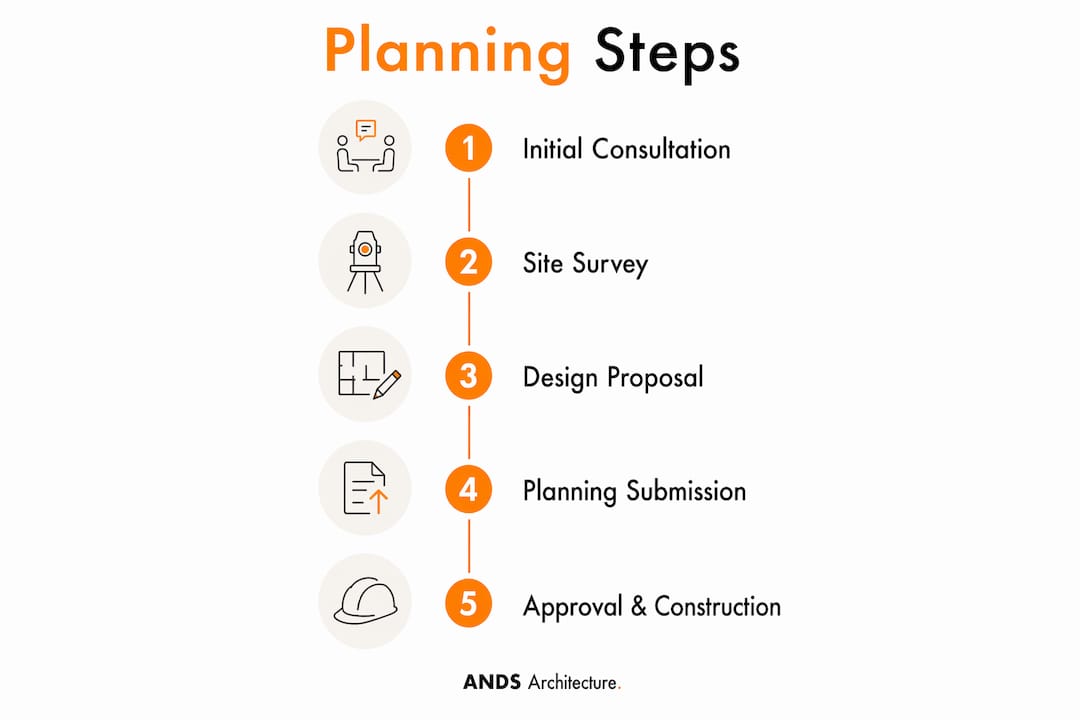
Planning applications in London require mandatory documentation including scale architectural drawings, location plans, and in many cases a Design and Access Statement. Missing or incorrect documents result in an invalid application. An invalid application does not start the statutory determination clock, meaning weeks of delay before your project even begins to be assessed.
The risks of an inadequate submission are concrete:
- Applications missing required drawing scales are returned as invalid by the council's validation team
- Design and Access Statements that fail to address local character or heritage context are a common reason for refusal in conservation areas across Ealing, Acton, and Chiswick
- Incorrect site boundary plans invalidate the entire application regardless of design quality
- Poorly described proposals leave case officers without the information needed to recommend approval
A qualified architect's experience with local planning officers and typical objections allows for strategic pre-application adjustments that improve success rates before formal submission. This is one of the most underestimated advantages of professional architectural input. An experienced architect knows which case officer concerns to address proactively, which neighbouring properties are likely to object, and which design elements a particular council will scrutinise most closely.
Hiring the wrong designer for a London planning application often causes delays, refusals, and increased costs due to insufficient understanding of local planning policies. A refusal is not simply an inconvenience. It creates a planning history on your property that future applications must address, and it can reduce your property's market value if the refusal is for a scheme that buyers would have valued.
What are the practical benefits of hiring an architect for your london project?
Beyond planning, the practical benefits of hiring an architect cover design quality, cost management, and project delivery. These three areas together determine whether your project finishes on time, within budget, and to a standard you are proud of.

| Benefit | Without an Architect | With a Qualified Architect |
|---|---|---|
| Design quality | Generic layouts based on builder preference | Bespoke design tailored to your site, lifestyle, and brief |
| Planning risk | High risk of invalid or refused applications | Compliant, well-prepared submissions with strategic input |
| Cost management | Costs often drift due to unclear specifications | Detailed drawings reduce contractor pricing ambiguity |
| Project oversight | Homeowner manages contractors directly | Architect coordinates trades, reviews work, and certifies stages |
| Regulatory compliance | Building regulations often addressed late | Building regulations integrated from concept stage |
Architects bring value through customised design and cost efficiencies that experienced professionals use to optimise space and manage contractors effectively. This adds savings that go well beyond the upfront fee. A well-specified set of construction drawings, for example, reduces the likelihood of contractors submitting inflated variations because the scope of work is unambiguous.
Space efficiency is another area where architectural expertise pays directly. London properties are expensive per square metre. An architect who understands how to maximise usable floor area within permitted development limits or planning constraints delivers genuine financial return. A loft conversion in Harrow or Watford that gains an additional bedroom through clever roof geometry adds more to resale value than the cost of the architect's fee.
Pro Tip: Ask your architect to produce a schedule of works alongside the technical drawings. This document helps contractors price accurately and gives you a clear basis for comparing quotes, which typically reveals significant variation in how different builders interpret the same design.
Architects also collaborate with planning consultants and structural engineers to deliver a coordinated approach on complex London projects. Integrated teams speed up approvals and reduce the risk of design conflicts emerging during construction, which are expensive to resolve on site.
How do architect fees work in london?
Architect fees in London follow three common structures. Understanding them before you engage a practice helps you budget accurately and avoid surprises.
- Percentage of construction cost. This is the most common model for residential projects. Fees typically range from 8% to 15% of the build cost, depending on project complexity and the scope of services required. A full service from concept through to site completion sits at the higher end.
- Lump sum fee. Suitable for well-defined scopes, such as a planning application for a rear extension. The architect agrees a fixed fee for a specific deliverable. This model suits homeowners who want cost certainty for a defined stage.
- Time-based billing. Used for undefined or evolving scopes, feasibility studies, or advisory work. The architect charges an agreed hourly or daily rate. This model requires careful monitoring to avoid cost overruns.
Fee transparency and upfront clarity are critical to matching client budgets with project scope and avoiding surprises later. Always request a written fee proposal that specifies exactly which services are included, what triggers additional charges, and how disbursements such as planning fees and structural engineer costs are handled.
For a typical London rear extension, expect architectural fees of £3,000 to £8,000 for a full planning and building regulations service. Loft conversions generally range from £4,000 to £10,000 depending on complexity. These figures vary by borough, practice size, and project specifics. They are a starting point for budgeting, not a fixed market rate.
How to choose the right architect in london
Selecting the right practice for your project requires more than reviewing a portfolio. London's planning environment rewards local knowledge, and the best design in the world does not help if the architect is unfamiliar with your borough's preferences.
- Verify ARB registration first. Confirm the lead architect is registered before any other conversation. This is non-negotiable.
- Review relevant project experience. A practice with completed projects in your London borough understands local planning history, conservation area policies, and typical case officer concerns. Local architects with proven experience in your borough increase the chances of successful planning permission.
- Ask for planning approval rates. A reputable practice will be able to discuss their track record with planning applications in London. High refusal rates are a warning sign.
- Request references from past clients. Speak directly with homeowners who have completed similar projects with the practice. Ask specifically about communication, budget management, and how problems were handled.
- Assess the initial consultation. A good architect listens carefully, asks detailed questions about your brief, and offers considered observations about your site before discussing fees. Generic responses suggest limited engagement with your specific project.
- Confirm the team. Understand who will actually work on your project. Some practices win commissions with senior architects but deliver work through junior staff. Clarify this before signing.
Key takeaways
Hiring a qualified, ARB-registered architect in London is the single most effective way to protect your investment, meet planning requirements, and achieve a design that adds lasting value to your property.
| Point | Details |
|---|---|
| ARB registration is mandatory | Only verify architects via the ARB register before signing any agreement. |
| London planning requires specialist knowledge | Each of London's 33 boroughs has distinct policies; local experience reduces refusal risk. |
| Architect fees are an investment | Professional fees typically save more than they cost through avoided refusals and efficient design. |
| Fee structures vary by scope | Agree a written fee proposal covering all stages before work begins to avoid unexpected costs. |
| Integrated teams deliver better outcomes | Architects who coordinate with engineers and planning consultants reduce delays and on-site conflicts. |
Why i always tell london homeowners to budget for the full service
By Afraz
After working with homeowners across London for over two decades, the pattern I see most often is this: the projects that run into serious trouble are almost always the ones where the client tried to save money by engaging an unqualified designer or asking an architect to do only part of the job.
I have seen planning applications for extensions in Ealing refused because the drawings did not address the council's local design guide. I have seen loft conversions in Harrow reach roof level before anyone noticed the structural calculations were missing, triggering a stop notice and a costly redesign. In both cases, the homeowners spent more fixing the problem than a full architectural service would have cost from the start.
The instinct to reduce fees is understandable. London projects are expensive, and every saving feels meaningful. But the architect's fee is not where the real risk sits. The real risk is in a refused planning application that creates a negative planning history, or a set of drawings so vague that every contractor prices a different job.
Treating the architect fee as an investment rather than a cost correlates directly with better project outcomes and fewer expensive mistakes. That is not a sales point. It is what the evidence from completed projects consistently shows. The homeowners who engage fully with their architect, share their brief clearly, and trust the process are the ones who end the project satisfied and on budget.
— Afraz
How Andsarchitecture supports london homeowners and developers
Andsarchitecture is a design-led practice with over 20 years of experience delivering residential, commercial, and development projects across London and the wider UK. Every project is led by ARB-registered architects with direct experience of London's planning system, from Islington and Ealing to Harrow, Acton, and Chiswick.

Our architectural services in London cover the full project lifecycle: measured surveys, concept design, planning applications, building regulations drawings, and site delivery. We work closely with homeowners and developers to produce bespoke, compliant designs that meet council requirements and reflect each client's specific brief. If you are ready to discuss your project, our team is available for an initial consultation to assess your site, outline the planning context, and provide a clear fee proposal.
Explore our planning services or view completed London projects to understand the standard of work we deliver.
FAQ
What does an architect do that a builder cannot?
An architect produces legally compliant design drawings, manages planning applications, and coordinates structural and regulatory requirements. A builder constructs to a specification but does not hold the professional qualifications or legal accountability of a registered architect.
Is ARB registration required for all architects in london?
Yes. The title "architect" is legally protected under the Architects Act 1997 and can only be used by those registered with the ARB. Using the title without registration is a criminal offence in the UK.
How much do architect fees cost for a london extension?
Fees for a typical London rear extension range from £3,000 to £8,000 for a full planning and building regulations service. The exact figure depends on project complexity, borough, and the scope of services agreed.
Do i need an architect for permitted development work?
Permitted development does not require planning permission, but you still need building regulations approval and technically accurate drawings. An architect ensures the work complies with both, reducing the risk of enforcement action or problems when you sell the property.
How do i verify an architect's credentials in london?
Search the ARB's publicly available register at arb.org.uk using the architect's name or practice. Confirm their registration number is current and ask them to provide it in writing before any contract is signed.